
Unlocking the Future: How Multimodal AI is Revolutionizing Personalized Customer Journeys in Digital Marketing
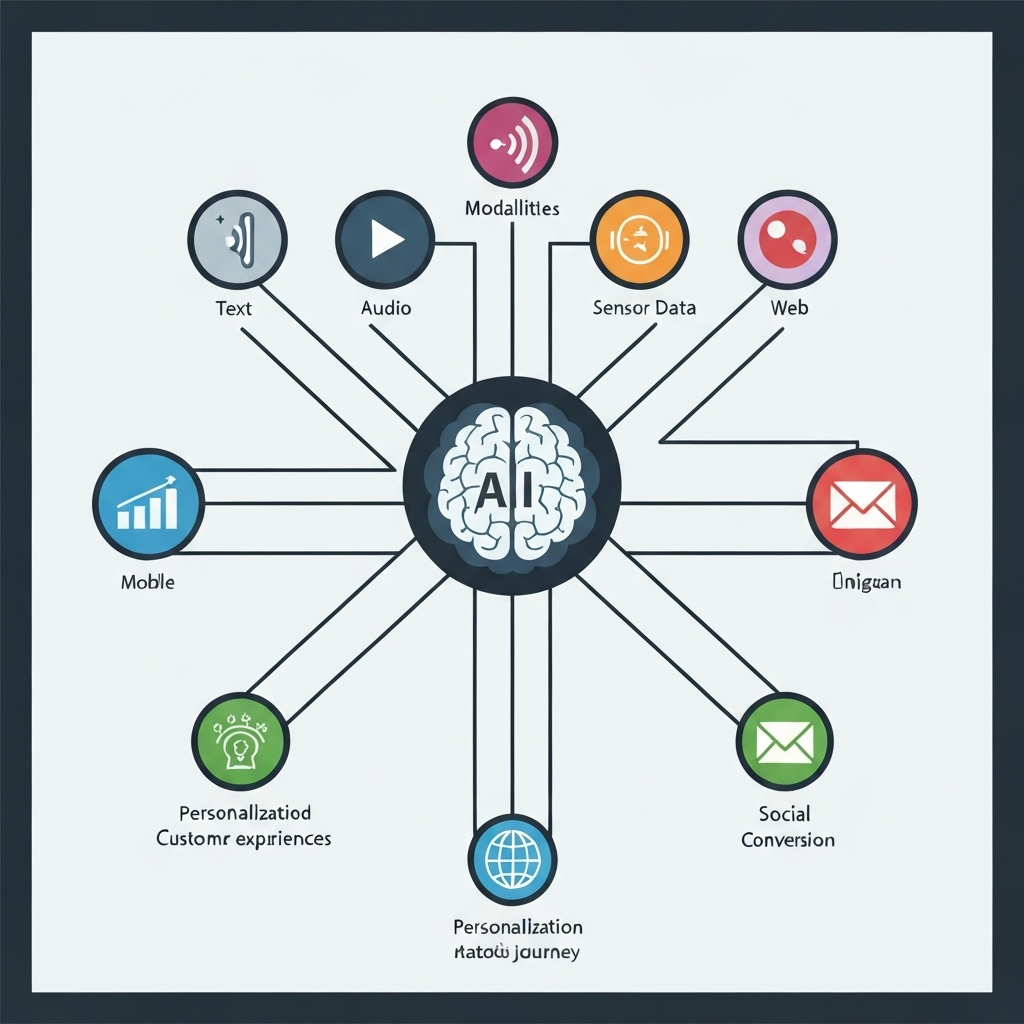
In today's digital landscape, personalized customer experiences are paramount. Multimodal AI empowers brands to cut through the noise by understanding individual preferences, behaviors, and intentions. Unlike traditional AI, which analyzes single data types, multimodal AI synthesizes insights from diverse modalities like text, images, audio, and video, unlocking new levels of personalization and customer journey optimization.
What is Multimodal AI and Why Does it Matter for Digital Marketing?
Multimodal AI processes information from multiple input data types simultaneously. This holistic comprehension allows businesses to craft bespoke customer journeys that resonate, foster loyalty, and drive ROI. It bridges gaps by providing a holistic customer view, enhanced contextualization, richer personalization, and improved predictions.
The Pillars of Multimodal AI in Action
Multimodal AI integrates several key components:
- Text Analysis (NLP): Extracts sentiment, identifies intent, and summarizes textual data.
- Image and Video Recognition (Computer Vision): Analyzes visual information to understand preferences and brand perception.
- Audio Processing: Interprets spoken language and non-speech audio cues.
- Sensor Data and Behavioral Tracking: Provides behavioral context from IoT devices and website interactions.
Transforming the Personalized Customer Journey with Multimodal AI
Multimodal AI enhances each stage of the customer journey, from awareness to advocacy, enabling customer journey optimization AI.
Awareness Stage:
AI generates personalized content and predicts preferred channels for initial outreach.
Consideration Stage:
Intelligent chatbots interpret text, voice, and images, leading to personalized product recommendations and adaptive content delivery.
Decision Stage:
AI dynamically personalizes offers and streamlines checkout experiences.
Retention & Loyalty Stage:
AI provides proactive customer service and personalized post-purchase communication.
Advocacy Stage:
AI identifies and empowers brand advocates with personalized content for sharing.
Key Benefits of Integrating Multimodal AI in Customer Experience
Multimodal AI yields significant improvements in hyper-personalization, customer engagement, satisfaction, retention, optimized marketing ROI, deeper customer insights, and provides a competitive advantage. It elevates AI in customer experience.
Navigating the Challenges: The Road to Multimodal AI Adoption
Challenges include data complexity, ethical considerations, technological infrastructure, the talent gap, and measuring ROI. Successfully addressing these opens doors to enhanced CX and market leadership.
Real-World Examples and Case Studies: Multimodal AI Applications in Marketing
Multimodal AI applications marketing span industries. E-commerce utilizes visual search and personalized shopping. Automotive benefits from intelligent in-car assistants. Healthcare employs AI for personalized coaching. Retail uses it for smart stores and hyper-personalized experiences. These examples showcase multimodal AI applications marketing offers.
Strategic Implementation Roadmap for Multimodal AI-Powered Personalization
A phased approach is crucial, starting with assessment, data integration, technology selection, model development, testing, optimization, and finally, scaling and cultural integration. This ensures advanced AI-powered personalization.
The Future of Marketing AI: Emerging Trends and Long-Term Potential
Emerging trends include hyper-contextualization, predictive experiences, ethical AI, human-AI collaboration, and individualization, pushing the boundaries of the future of marketing AI.
Conclusion
Multimodal AI is crucial for customer journey optimization AI. By harmonizing insights from various data sources, it empowers personalized customer journeys, enhancing AI in customer experience. Successfully implementing it paves the way for digital marketing innovation. Embracing multimodal AI is essential for the future of marketing AI.