
Your 90-Day Roadmap: An Ultimate Guide to AI for Small Business Marketing
Published on September 7, 2025
# Your 90-Day Roadmap: An Ultimate Guide to AI for Small Business Marketing
As a small business owner, you wear countless hats. You're the CEO, the head of product, the customer service lead, and, of course, the entire marketing department. This often means marketing happens in fits and starts—a frantic social media post here, a rushed email blast there. It's a state of organized chaos, driven by reaction rather than strategy. You know you need a clear plan, but finding the time, budget, and expertise to build and execute one feels like an insurmountable challenge.
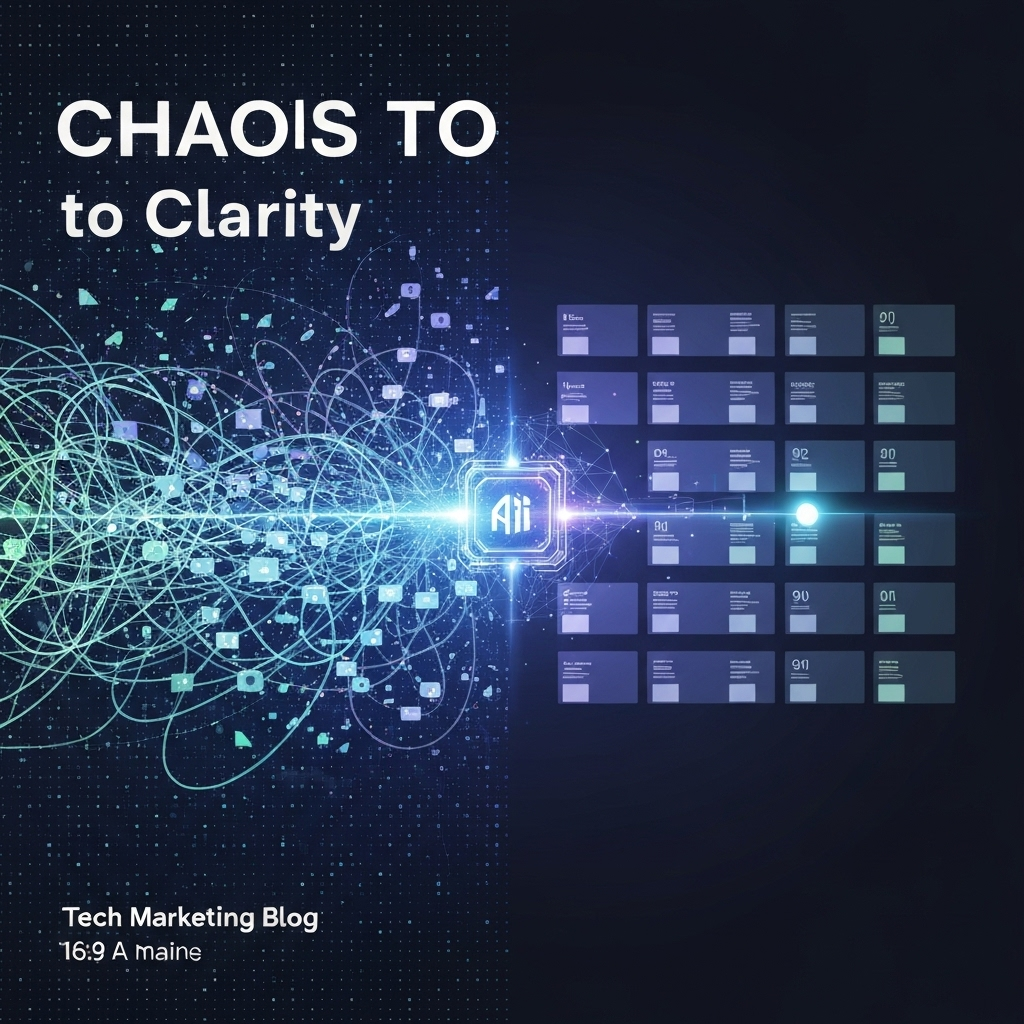
What if you could trade that chaos for clarity? What if you had a brilliant, data-driven marketing assistant working 24/7 to help you strategize, create, and optimize? This is no longer a far-off fantasy; it's the accessible reality offered by artificial intelligence. Using **AI for small business marketing** is the single most powerful lever you can pull to level the playing field, save precious time, and achieve measurable growth.
This is not another article filled with abstract theories. This is your ultimate guide, a practical, step-by-step 90-day roadmap designed to take you from reactive marketing to a proactive, AI-powered strategy. We will walk you through building your foundation, activating your campaigns, and optimizing for long-term success. By the end of this journey, you'll have a clear, sustainable marketing system that works for you, not the other way around.
## Month 1 (Days 1-30): Laying the Foundation with AI Strategy
The first 30 days are about shifting your mindset and building the strategic bedrock for everything that follows. Before you can execute, you must have a clear direction. This is where you'll use AI not to *do* the work, but to *inform* the work. We'll move from guesswork to data-driven decision-making, setting the stage for a successful marketing launch.
The core benefits of integrating AI into your marketing from day one are transformative for a small business. First, you gain back your most valuable asset: time. AI automates repetitive tasks like data analysis, content brainstorming, and report generation. Second, you gain unprecedented customer insights. AI can analyze market trends, competitor behavior, and customer data at a scale and speed no human can match. Finally, and most importantly, you improve your return on investment (ROI). By making smarter decisions about where to focus your efforts and budget, AI ensures every marketing dollar works harder.
Your first task is to establish clear, measurable goals for this 90-day period. Vague objectives like "get more customers" are not enough. Instead, use the SMART framework (Specific, Measurable, Achievable, Relevant, Time-bound). For example:
* Increase qualified leads from our website by 15% within 90 days.
* Grow our Instagram follower engagement rate by 20% in the next 60 days.
* Generate 50 new email subscribers per week for the next 3 months.
With these goals in hand, you can now leverage AI to figure out *how* to achieve them. This initial phase is all about using AI tools for deep market research, robust competitor analysis, and pinpointing your ideal target audience. You'll also identify the main categories of beginner-friendly **AI advertising tools** that will become the engine of your strategy.
### How to Use AI in Marketing for Initial Research
Traditionally, market research was a costly and time-consuming endeavor reserved for large corporations. Today, AI puts the power of a world-class research department at your fingertips. This is a crucial step in understanding **how to use AI in marketing** effectively. Instead of guessing what your customers want or what your competitors are doing, you can ask an AI and get data-backed answers in minutes.
Here’s how to approach it:
1. **Competitor Analysis:** Use a tool like ChatGPT or a dedicated SEO platform with AI features (like Semrush). You can provide the AI with the URLs of your top 3-5 competitors and use prompts like:
* "Analyze the content strategy of these competitors. What are the common themes, formats (blogs, videos, case studies), and keywords they are targeting?"
* "Identify the primary value propositions and marketing messages used on these competitor websites. What are their strengths and weaknesses?"
* "Based on their social media profiles, what is their tone of voice and what kind of content drives the most engagement for them?"
2. **Audience Persona Development:** Understanding your customer is everything. AI can help you move beyond basic demographics to build rich, detailed personas. Use a tool like SparkToro to discover what your target audience reads, watches, listens to, and follows online. You can then feed this information into a generative AI tool with a prompt like:
* "Create a detailed customer persona for a 35-year-old urban professional who is interested in sustainable fashion, follows these three influencers ([Influencer A], [Influencer B]), and reads [Publication C]. Include their pain points, motivations, and preferred communication channels."
3. **Topic and Keyword Discovery:** Find out what your audience is actively searching for. Use AI-powered keyword research tools to identify questions people are asking related to your industry. A prompt for ChatGPT could be:
* "I own a local, artisanal coffee shop. Generate a list of 50 long-tail keywords and blog post ideas that potential customers in my area might be searching for. Focus on topics related to coffee brewing methods, bean sourcing, and community events."
This AI-driven research isn't just an academic exercise. The insights you gather will directly inform your content calendar, your ad targeting, your messaging, and your overall marketing plan. It's the foundation upon which everything else is built.
### Selecting Your First AI Advertising Tools
With your research complete and goals defined, it's time to choose your toolkit. The market for **AI advertising tools** is vast and can be overwhelming. The key in Month 1 is to start small and focus on tools that are cost-effective, user-friendly, and solve an immediate problem for your business. Don't try to adopt a dozen new platforms at once. Pick one or two to master first.
Here are the key categories to consider and some popular, SMB-friendly options:
* **Content Creation & Copywriting:** These tools help you overcome writer's block and generate high-quality drafts for blogs, social media, emails, and ads. They are your creative assistants.
* *Examples:* Jasper, Copy.ai, Writesonic. Most offer free trials or tiered pricing that can scale with your needs.
* **Social Media Management:** These platforms use AI to help you schedule posts at optimal times, suggest relevant hashtags, and even generate caption ideas based on your images or links.
* *Examples:* Buffer, Later, Hootsuite. Their AI features are designed to streamline your workflow and boost engagement.
* **Email Marketing:** Modern email platforms are infused with AI to help you write better subject lines, personalize content for different audience segments, and optimize send times for maximum open rates.
* *Examples:* Mailchimp, ConvertKit, Brevo. Look for features specifically labeled as "AI-powered" or "optimization engines."
When choosing, prioritize tools that offer a free tier or a low-cost entry point. Read reviews, watch tutorials, and make sure the user interface feels intuitive to you. The goal for Month 1 is to get comfortable with your chosen tools so you're ready to hit the ground running in Month 2.
## Month 2 (Days 31-60): Activating Your Plan with Automated Marketing for SMBs
Welcome to Month 2. The foundation is laid, your goals are set, and your tools are chosen. Now, it's time for execution. This month is all about activating your strategy and leveraging **automated marketing for SMBs** to bring your plan to life. We'll move from planning to doing, using AI to create, schedule, and launch your marketing campaigns.
During this phase, you'll use the insights from your research to guide AI content generators in creating a full content calendar. You'll draft blog posts that answer your audience's burning questions, create engaging social media updates that reflect your brand's personality, and write compelling email campaigns that nurture leads.
This is also the month where we'll dip our toes into the powerful world of AI-driven advertising. You'll learn the basics of setting up your first campaigns, a process that AI has made significantly more accessible for small businesses. A critical theme for this month is the principle of "quality in, quality out." AI tools are incredibly powerful, but their output is only as good as the inputs you provide. High-quality creative assets (images, videos), clear audience signals from your research, and well-defined campaign objectives are non-negotiable for success.
### Streamlining Content Creation and Distribution
Content is the fuel for your marketing engine, but it's often the biggest bottleneck for time-strapped entrepreneurs. This is where an AI-assisted workflow can be a game-changer. The goal isn't to have AI replace your creativity, but to augment it, making the process faster and more efficient.
Here’s a practical workflow for creating a cornerstone piece of content, like a blog post, with AI:
1. **Brainstorming & Ideation (15 minutes):** Go to your chosen AI writing assistant. Use a prompt based on your Month 1 research: "Acting as a content strategist for a small accounting firm targeting freelance creatives, generate 15 blog post titles about tax tips for the self-employed. Make them engaging and address common pain points like quarterly taxes and deductible expenses."
2. **Outlining (10 minutes):** Select your favorite title. Then, prompt the AI: "Create a detailed blog post outline for the title 'The 5 Biggest Tax Mistakes Freelancers Make and How to Avoid Them.' Include an introduction, a section for each mistake with actionable advice, and a conclusion with a call-to-action."
3. **Drafting (20 minutes):** Now, have the AI flesh out each section of the outline. You can do this one section at a time to maintain control. "Write a 300-word introduction for this blog post, using a relatable tone that speaks directly to creative freelancers."
4. **Human Oversight & Polishing (60+ minutes):** This is the most critical step. The AI has given you a solid B+ draft in under an hour. Now it's your turn to make it an A+. Read through the entire text. Fact-check any claims or statistics. Inject your unique brand voice, personal anecdotes, and expert insights. Refine the language, ensure it flows well, and check for any awkward phrasing. The AI provides the structure; you provide the soul.
Once your cornerstone content is complete, use AI to repurpose it. Prompt your tool: "Turn the key points from this blog post into 5 engaging Twitter threads," or "Write a 200-word email newsletter summarizing this article for my subscribers." This maximizes the value of your efforts, turning one piece of content into a week's worth of marketing assets.
### A Primer on Google Ads AI Automation
For many small businesses, paid advertising feels like a casino where the house always wins. It can be complex, expensive, and unforgiving. However, **Google Ads AI automation** has fundamentally changed the game, making it more accessible and effective for those with limited budgets and expertise.
Instead of manually picking keywords, setting bids, and targeting specific placements, Google's AI can now do the heavy lifting. The premier example of this is the Performance Max (PMax) campaign type. Think of PMax as your automated advertising strategist. You provide it with the essential ingredients, and its machine learning algorithms work to find you the most valuable customers across all of Google's channels—Search, YouTube, Display, Discover, Gmail, and Maps—all from a single campaign.
Here’s a simplified step-by-step to setting up your first PMax campaign:
1. **Define Your Objective:** Tell Google what you want to achieve. Is it online sales, lead form submissions, or phone calls? A clear conversion goal is essential.
2. **Set Your Budget:** Start with a modest daily budget you're comfortable with. You can always scale up later.
3. **Provide Creative Assets:** This is your input. Upload a variety of high-quality images, logos, videos, and text headlines/descriptions. The more assets you provide, the more combinations the AI can test to find what resonates with your audience.
4. **Give Audience Signals:** While PMax automates targeting, you can give it a head start. Provide signals like your customer email lists, website visitor data (retargeting), or information about your target demographics and interests. The AI uses this as a starting point to find similar audiences.
By entrusting the complex targeting and bidding to the machine, you can focus on the strategic elements: your messaging, your offer, and your creative. This approach helps you sidestep many [common advertising mistakes](/blog/5-common-ad-mistakes) that new advertisers make, such as bidding incorrectly or targeting too narrowly. The AI's job is to find the most efficient path to your goal, saving you time and money.
## Month 3 (Days 61-90): Optimizing Performance and Scaling for Growth
With your content engine running and your first AI-driven ad campaigns live, Month 3 is all about optimization and intelligent scaling. The focus shifts from setup and execution to analysis and improvement. This is where the true power of **AI for small business marketing** shines, turning raw data into actionable insights that drive real growth.
During this final phase of your 90-day roadmap, you'll learn how to interpret the performance reports generated by your AI tools. It’s not just about looking at clicks and impressions; it’s about understanding the story the data tells. We'll explore how you can use AI to conduct rapid A/B testing on everything from ad copy and headlines to email subject lines, allowing you to continuously iterate and improve your results.
Based on this data-driven feedback loop, you'll develop a clear plan for scaling what works and reallocating your budget away from underperforming efforts. This process of continuous optimization ensures that your marketing strategy doesn't become stale. It evolves, adapts, and gets smarter over time, just like the AI that powers it.
### Using AI Analytics to Measure What Matters
Your AI marketing tools will generate a wealth of data. The challenge is to focus on the metrics that truly impact your business objectives. It's easy to get distracted by "vanity metrics" like social media likes or website traffic. While these have their place, your primary focus should be on metrics that connect directly to your bottom line: conversion rates, cost per acquisition (CPA), and customer lifetime value (CLV).
Many AI platforms have built-in analytics dashboards that go beyond simple data presentation. They use machine learning to surface key insights, identify performance trends, and even offer optimization suggestions in plain English. For example, your Google Ads dashboard might highlight that a specific combination of a headline and an image is driving a significantly lower CPA than others, prompting you to allocate more budget towards it.
When analyzing your performance, the most critical metric to grasp is Return on Ad Spend (ROAS). This tells you how much revenue you're generating for every dollar you spend on advertising. A deep dive into [understanding ROAS](/blog/what-is-roas) is essential for any small business owner running paid ads. It is the ultimate measure of profitability and the key indicator of whether your campaigns are a worthwhile investment. Use your AI-generated reports to track ROAS closely and make informed decisions about your budget.
Furthermore, you can use AI to A/B test your marketing assets systematically. Instead of manually creating two versions of an ad, you can ask an AI tool to generate five different headlines and three different descriptions. You can then load all of these into an AI-powered ad platform like Google Ads, which will automatically test all the possible combinations and learn which ones perform best, saving you weeks of manual testing.
### Your Roadmap Beyond 90 Days
Congratulations! By the end of Month 3, you will have successfully transitioned from chaotic, reactive marketing to a structured, data-driven, and AI-powered system. But this 90-day plan is not a finish line; it's the starting line for a new, more effective way of marketing your business.
The world of AI is evolving at a breakneck pace. Your roadmap beyond these 90 days should be built on a foundation of continuous learning and experimentation. Here are some potential next steps to explore as you grow in confidence:
* **AI-Powered Chatbots:** Implement a simple AI chatbot on your website to handle common customer inquiries 24/7, freeing up your time and improving the customer experience.
* **Predictive Analytics:** Explore tools that use AI to predict future trends, forecast sales, or identify customers who are at risk of churning, allowing you to be proactive in your retention efforts.
* **Advanced Personalization:** Use AI to personalize the user experience on your website, showing different content or offers to different visitor segments based on their past behavior.
Establish a cycle of testing, learning, and iterating. Dedicate a small portion of your marketing budget each month to experimenting with a new AI tool, a new campaign type, or a new marketing channel. What works today may not work in six months, and an agile, AI-informed approach is your best defense against irrelevance.
## Conclusion
Over the past 90 days, you've embarked on a transformative journey. You started in a state of marketing chaos, armed with limited time and resources. In Month 1, you laid a strategic foundation, using AI to understand your market and customers with unprecedented clarity. In Month 2, you activated that strategy, leveraging **automated marketing for SMBs** to create and distribute content and launch intelligent ad campaigns. Finally, in Month 3, you learned to optimize and scale, turning data into decisions and investment into profitable growth.
This roadmap demonstrates that **AI for small business marketing** is not an intimidating, futuristic concept reserved for tech giants. It is a practical, accessible, and powerful amplifier for entrepreneurs. It doesn't replace your expertise, your passion, or your connection with your customers. It enhances it, freeing you from mundane tasks so you can focus on what you do best: running your business.
AI empowers you to make smarter, faster decisions, turning your marketing from a cost center into a predictable engine for growth. The journey from chaos to clarity is within your reach. Don't feel you need to do everything at once. The path forward starts with a single step. Choose one tool, tackle the first task from Month 1, and begin your 90-day plan today.