
Beyond the Chatbot: How OpenAI's GPT-4o is Redefining the Future of Customer Interaction
Published on September 9, 2025
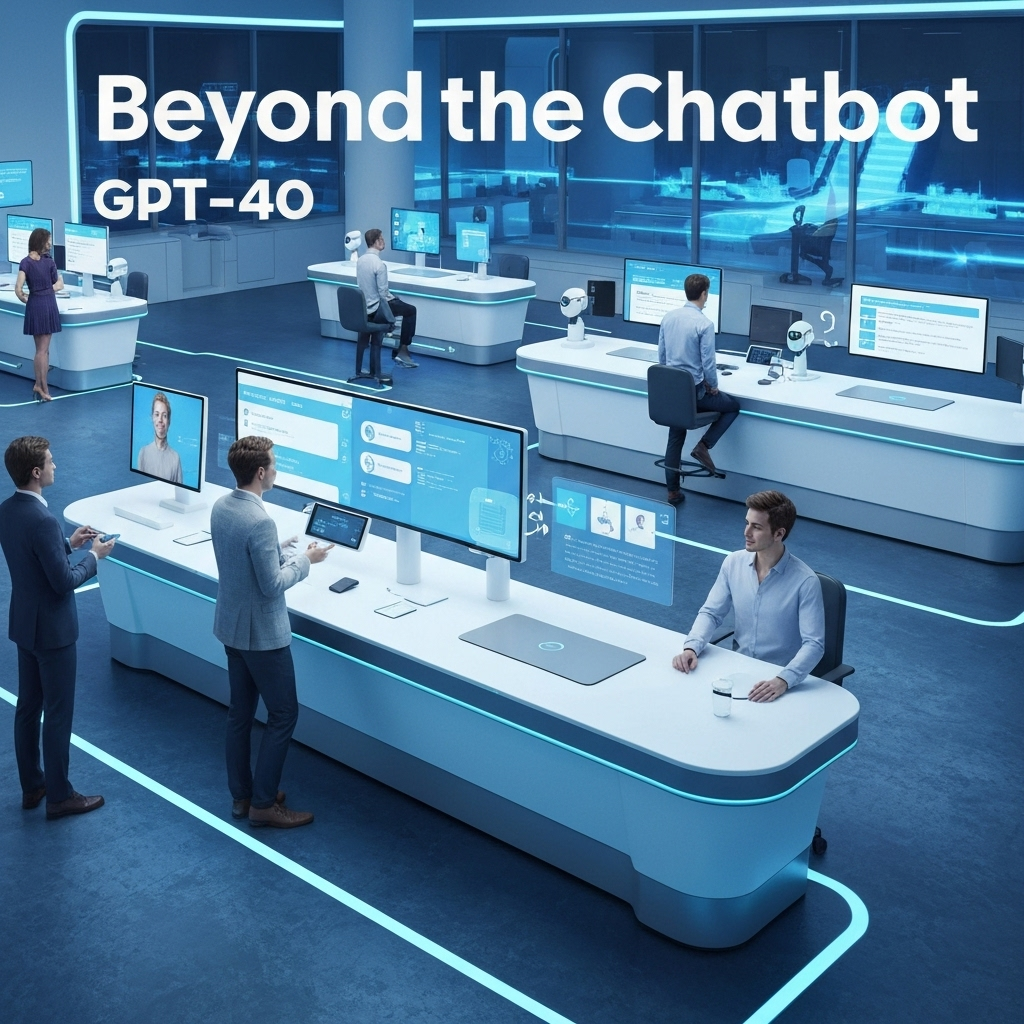
Beyond the Chatbot: How OpenAI's GPT-4o is Redefining the Future of Customer Interaction
What if your next call to customer support felt less like navigating a frustrating phone tree and more like a seamless conversation with a hyper-competent expert? Imagine an assistant that can not only hear the urgency in your voice but also see the exact problem you're pointing at with your phone's camera, guiding you to a solution in seconds. This isn't a scene from a sci-fi movie; it's the new reality being ushered in by breakthroughs in artificial intelligence. The era of clunky, text-only chatbots is officially over, and the implications for your business are staggering.
This article dives deep into the revolution happening right now in the world of GPT-4o customer interaction. We will explore what OpenAI's GPT-4o, with its native multimodal capabilities, actually is and why it represents a quantum leap from its predecessors. We'll unpack its ability to process text, audio, and images in real time and, most importantly, examine the concrete ways this technology is already starting to reshape the future of customer service.
Having spent over a decade at the intersection of AI development and customer experience strategy, I've witnessed countless technologies promise to change the game. Few, however, have carried the truly transformative potential of a model like GPT-4o. We are moving from programmed responses to genuine, context-aware conversations.
By the end of this guide, you won't just understand the theory behind this powerful new tool. You will have a clear, strategic vision of how to apply it, turning your customer support from a necessary cost center into a powerful engine for satisfaction, loyalty, and unprecedented business growth. Let's begin.
The Old Guard: Why Traditional Customer Interaction is Failing
Before we can appreciate the magnitude of the shift GPT-4o brings, we must first acknowledge the deep-seated frustrations with the status quo. For years, businesses have tried to scale customer support through automation, but the results have often been underwhelming for the most important person in the equation: the customer.
The Era of Scripted Frustration
Think about your last interaction with an automated system. You likely encountered a chatbot that got stuck in a loop, repeatedly asking, "I'm sorry, I didn't understand that." Or perhaps you navigated a rigid Interactive Voice Response (IVR) system, pressing '1' for sales and '2' for support, only to be disconnected or misunderstood after a long wait.
These systems operate on a simple, keyword-based logic. They are programmed with flowcharts and scripts, unable to handle nuance, context, or any query that deviates slightly from their pre-defined path. They lack the ability to understand human emotion, interpret complex problems, or switch contexts gracefully. The result? Customers feel unheard, frustrated, and ultimately, less valued by the brand.
The Siloed Experience
The problem extends beyond a single channel. A customer might start with a chatbot, get frustrated, send an email, and then finally call support. In most organizations, each of these touchpoints is a separate silo. The human agent who eventually picks up the phone often has no context from the previous interactions, forcing the customer to repeat their issue for the third time. This disjointed experience erodes trust and efficiency, turning a simple query into a prolonged ordeal.
This old model is not just bad for customers; it's inefficient for businesses. It leads to higher call volumes for human agents, who spend most of their time handling repetitive issues that automation was supposed to solve. It creates a cycle of frustration and churn that directly impacts the bottom line.
Enter GPT-4o: The Dawn of Truly Conversational AI
OpenAI's GPT-4o, with the 'o' standing for 'omni,' is not merely an incremental update. It is a fundamental architectural redesign that tears down the walls between different modes of communication. Unlike previous models that processed voice and vision through separate, slower components, GPT-4o was built from the ground up to be natively multimodal.
The Power of 'Omni': Unpacking Multimodality
Multimodality means the model can seamlessly understand and generate a combination of text, audio, and image inputs and outputs. It doesn't translate voice to text, process it, and then convert text back to speech. It processes the raw audio directly, allowing it to pick up on subtleties that are lost in transcription, such as tone, emotion, background noise, and even multiple speakers.
- Audio Intelligence: It can identify happiness, frustration, or urgency in a speaker's voice and respond with an appropriate tone. It can laugh, sing, and change its emotional expression in real time.
- Visual Understanding: It can look at a screenshot, a live video feed from a phone, or a photo and understand the content. It can read text on a screen, identify objects, and interpret charts and graphs.
- Integrated Reasoning: The true magic happens when these modalities are combined. A user can speak, show a video, and type a question all in the same interaction, and GPT-4o can synthesize all of this information to provide a coherent and context-aware response.
Speed and Empathy: The Real-Time Advantage
One of the most significant breakthroughs of GPT-4o is its speed. It can respond to audio inputs in as little as 232 milliseconds, with an average of 320 milliseconds—a timeframe comparable to human conversational response times. This near-instantaneous feedback loop eliminates the awkward pauses and delays that plagued previous voice AI, making interactions feel natural and fluid.
This speed isn't just a technical achievement; it's the key to creating empathetic and effective AI in customer support. A natural, flowing conversation builds rapport and trust. When a customer feels that they are being understood in real time, without frustrating delays, their entire experience is elevated.
7 Ways GPT-4o is Redefining Customer Interaction
Now, let's move from the 'what' to the 'how.' How will these groundbreaking capabilities translate into tangible improvements for your customer experience? Here are seven practical applications that are set to revolutionize the industry.
1. The Empathetic Voice Assistant: Beyond Robotic IVR
The dreaded IVR system is on its way out. With GPT-4o, customers calling for support will be greeted by a voice assistant that sounds astonishingly human. Imagine a customer, clearly frustrated, calling about a damaged delivery. The model can immediately detect the stressed tone in their voice.
Instead of a robotic "How can I help you?" it might respond with a calming, empathetic tone: "I can hear you're upset, and I'm really sorry to hear your package arrived damaged. Let's get this sorted out for you right away." The AI can then guide the customer through the process, maintaining a supportive tone and adjusting its approach based on the customer's emotional cues throughout the conversation. This single change transforms a transactional, often negative, interaction into a relationship-building experience.
2. "See What I See" Visual Support
This is perhaps the most powerful application for any business with a physical product or complex software. Consider a customer struggling to assemble a piece of furniture. Instead of trying to describe a confusing diagram over the phone, they can simply activate their phone's camera. GPT-4o can watch the live video feed.
The customer points the camera at the parts and asks, "I'm not sure where this screw is supposed to go." The AI can see the screw and the pre-drilled holes, circle the correct spot on the customer's screen, and say, "I see it. That screw goes into the small hole right there, next to the larger bracket. Let me highlight it for you." This removes all ambiguity, dramatically shortens resolution times, and empowers customers to solve problems themselves with expert guidance.
3. Real-Time Translation and Global Support
For global companies, language barriers are a significant operational hurdle, often requiring expensive, geographically dispersed support teams. GPT-4o can act as a universal translator in real time. A customer in Japan can speak in Japanese, and a support agent in the United States can hear them in English, and vice-versa.
The model handles the translation seamlessly during the live conversation, preserving the natural flow and even the emotional intent of the speakers. This capability allows businesses to centralize their support teams while offering high-quality, native-language support to their entire global customer base, 24/7. It's a game-changer for scalability and international market penetration.
4. Proactive and Predictive Engagement
Why wait for a customer to get stuck? With its vision capabilities, GPT-4o can be integrated into websites and applications to provide proactive support. Imagine a user is on a complex checkout page and has been hovering their mouse over the 'promo code' field for an extended period, or repeatedly clicking between shipping options. The system can interpret this visual behavior as confusion.
A helpful, non-intrusive chat window could pop up with a friendly voice or text: "It looks like you might be having some trouble with the shipping options. Did you know we offer free two-day shipping on orders over $50?" This anticipatory help can prevent cart abandonment, reduce frustration, and guide customers smoothly through their journey.
5. Hyper-Personalized Onboarding and Training
Onboarding new users to a complex software platform is a critical, yet often challenging, process. GPT-4o can serve as a personal onboarding specialist for every single user. It can guide them through the software's interface, ask them about their goals, and tailor the tour to their specific needs.
The user can ask questions verbally ("How do I create an invoice?") while sharing their screen. The AI can see exactly where they are in the application and provide step-by-step instructions, even highlighting the buttons they need to click. This one-on-one, interactive training scales infinitely and ensures every user feels confident and capable from day one, dramatically increasing adoption and long-term retention.
6. Instantaneous Data Analysis and Agent Assist
GPT-4o isn't just for customer-facing roles; it's also a powerful tool for empowering human agents. In an 'agent assist' mode, the AI can listen in on a support call. While the human agent is talking to the customer, GPT-4o can be working in the background.
It can instantly pull up the customer's purchase history, analyze the transcript of the conversation in real time to identify the core issue, and feed the agent relevant knowledge base articles, troubleshooting steps, and even suggested empathetic phrases on their screen. This allows the human agent to focus entirely on the customer relationship and problem-solving, rather than frantically searching for information. It reduces training time for new agents and boosts the performance of the entire team.
7. Creating Richer, More Accessible Experiences
The multimodal capabilities of GPT-4o have profound implications for accessibility. For a visually impaired user, the AI can act as a pair of seeing eyes. They could point their phone camera at a new appliance and have the AI describe the buttons and their functions. They could use it to read their mail or identify the products on a grocery store shelf.
By integrating this technology, brands can make their products and services accessible to a much wider audience. This is not only an ethical imperative but also a significant business opportunity. Designing for accessibility improves the experience for all users and builds a brand reputation centered on inclusivity and care.
Strategic Implementation: Moving from Concept to Reality
The potential of GPT-4o is clear, but realizing that potential requires a thoughtful and strategic approach. Simply plugging in a new tool without a plan is a recipe for failure. Here’s how business leaders should prepare for this new era of customer interaction.
Start with the Right Use Case
Don't try to boil the ocean. Begin by identifying a specific, high-impact pain point in your current customer journey. Is it long call wait times? High rates of product returns due to setup issues? Low conversion rates on a complex sign-up form? Start with a pilot project focused on solving one of these problems. For example, implement a visual support tool for your most complex product first. Measure the results, learn from the experience, and then scale your efforts.
Prioritize Data Privacy and Security
With AI that can see and hear customer interactions, data privacy becomes more critical than ever. It's essential to work with platforms and partners who prioritize security. Ensure you have clear policies on data handling, storage, and anonymization. Be transparent with your customers about how their data is being used to improve their experience. Building and maintaining trust is paramount; a single misstep can do irreparable damage to your brand.
Redefine the Role of the Human Agent
GPT-4o will not replace human agents; it will elevate them. Repetitive, simple queries will be handled almost entirely by AI, freeing up human agents to focus on the most complex, sensitive, and high-value interactions. The role of a support agent will evolve into that of a brand ambassador, a relationship manager, and an expert problem-solver. Invest in training your team for these new responsibilities. Focus on skills like empathy, critical thinking, and managing complex customer escalations—areas where the human touch remains irreplaceable.
The Road Ahead: Navigating the Future of AI-Powered Relationships
We are standing at the threshold of a new paradigm in the relationship between brands and customers. The move towards multimodal, real-time AI like GPT-4o is not just a technological upgrade; it's a fundamental shift in how we communicate. The future of customer service will be defined by personalization, proactivity, and profound empathy, delivered at an unprecedented scale.
Of course, this journey comes with challenges. We must navigate the ethical considerations of emotionally intelligent AI, ensure transparency, and manage the societal impact on the workforce. However, the opportunity is immense. The businesses that embrace this change, think strategically, and place the customer at the center of their AI implementation will not only survive but thrive. They will build stronger, more loyal customer relationships and set a new standard for what an exceptional customer experience can be.