
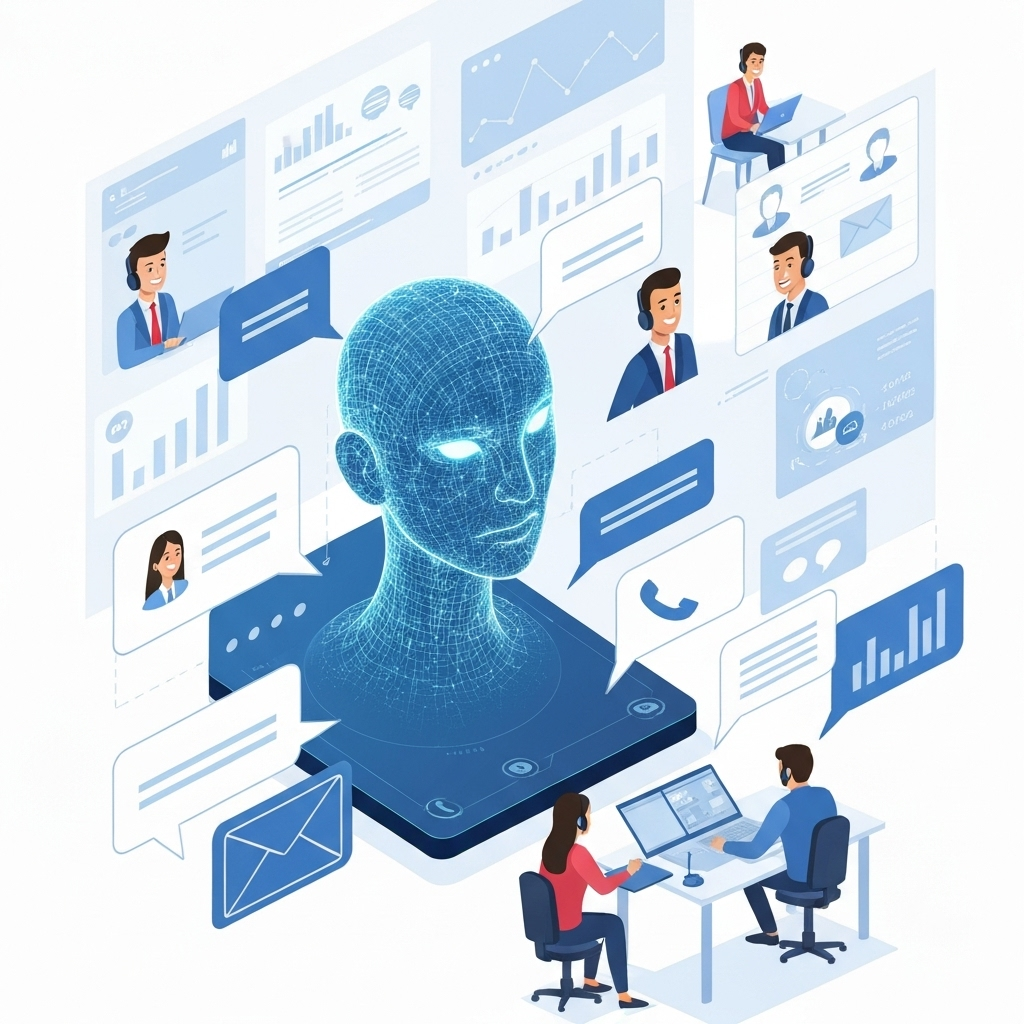
Customer expectations are soaring in today's digital world. They demand instant, personalized support, a challenge for traditional customer service models. SaaS companies also face difficulties scaling support efficiently. AI agents offer a solution, going beyond basic chatbots to deliver intelligent, personalized support and drive business growth. This guide explores how AI agents are revolutionizing customer service and SaaS, offering insights into their implementation and future trends.
AI Agents: Elevating Customer Service and SaaS
AI agents are transforming how businesses interact with customers, optimizing every touchpoint for efficiency, satisfaction, and strategic advantage. This comprehensive guide delves into the potential of AI agents, their impact on customer service and SaaS, and actionable insights for successful adoption.
Distinguishing AI Agents from Chatbots
AI agents are far more sophisticated than simple chatbots. While chatbots follow pre-scripted rules, AI agents possess advanced capabilities enabling contextual understanding, learning, and personalized support.
Key components of AI agents include:
- Natural Language Processing (NLP) and Understanding (NLU): Enabling interpretation of human language, understanding intent, and context.
- Machine Learning (ML): Continuous learning and improvement from every interaction.
- Context Retention: Remembering previous interactions for personalized, seamless experiences.
- Integrations: Connecting with backend systems (CRM, ERP) to perform complex tasks.
These capabilities allow AI agents to solve problems, guide users, and proactively engage, redefining customer engagement and operational efficiency.
Reshaping Customer Service with AI Agents
AI agents address pain points, enhance efficiency, and elevate customer experience.
Enhanced Efficiency and Scalability
- 24/7 Availability: Round-the-clock support boosts satisfaction.
- High-Volume Handling: Managing thousands of concurrent inquiries seamlessly.
- Reduced Wait Times: Automating responses to common queries.
- Freeing Human Agents: Allowing focus on complex issues requiring empathy.
Elevating Customer Experience
- Personalized Responses: Tailored answers based on individual needs.
- Consistent Brand Voice: Uniform communication across interactions.
- Omnichannel Presence: Seamless support across multiple platforms.
- Proactive Support: Anticipating and resolving issues before they arise.
- Smooth Handoffs: Transferring complex queries to human agents with full context.
Data-Driven Insights
- Data Collection: Logging every interaction for valuable insights.
- Identifying Trends: Uncovering patterns and areas for improvement.
- Informing Strategies: Using data to refine products and services.
AI Agents in SaaS: A Competitive Advantage
In the SaaS landscape, AI agents offer a distinct edge.
Streamlined Onboarding
- Guided Tutorials: Helping new users navigate setup and features.
- Contextual Help: Offering real-time assistance within the application.
- Proactive Troubleshooting: Identifying and resolving potential issues early on.
Empowering Self-Service
- Knowledge Base Access: Providing instant answers to complex questions.
- Guided Problem-Solving: Leading users through troubleshooting steps.
- Reduced Support Tickets: Empowering users to resolve issues independently.
Personalized User Journeys
- Tailored Recommendations: Suggesting relevant features and workflows.
- Usage-Based Support: Offering personalized tips based on user behavior.
- Anticipating Needs: Proactively offering assistance based on predictive analytics.
Accelerated Feedback Loops
- Collecting Feedback: Facilitating easy input from users.
- Analyzing Feedback: Categorizing and identifying key themes.
- Informing Development: Using feedback to improve products and features.
Implementing AI Agents: A Strategic Roadmap
Defining Objectives
- Identify Problems: Clearly define the challenges you aim to address.
- Target Customer Journeys: Pinpoint areas where AI agents can have the biggest impact.
- Start Small: Begin with a pilot program and scale gradually.
Choosing the Right Platform
- Evaluate Options: Consider in-house vs. third-party solutions.
- Prioritize Integrations: Ensure seamless connection with existing systems.
- Consider Scalability: Choose a platform that can grow with your business.
Data Collection and Training
- Quality Data: Use clean and relevant data for training.
- Human Oversight: Involve human agents in training and feedback.
- Ethical Considerations: Prioritize data privacy and security.
Human-AI Collaboration
- Seamless Handover: Define clear protocols for escalating to human agents.
- AI-Powered Agents: Equip human agents with AI insights for better support.
Iteration and Optimization
- Monitor Metrics: Track key performance indicators (KPIs).
- A/B Testing: Continuously test and refine AI responses and flows.
Case Studies
E-commerce: Reducing Cart Abandonment
An AI agent offered proactive support during checkout, reducing cart abandonment and increasing conversions.
Telecom: Handling Billing Inquiries
An AI agent handled over 60% of billing inquiries, freeing human agents for complex issues.
SaaS: Improving Onboarding
An integrated AI agent streamlined onboarding and reduced support tickets by 45%.
Overcoming Challenges and Best Practices
Data Privacy
- Ensure compliance with data protection regulations.
- Implement robust security measures.
Maintaining Human Touch
- Design empathetic interactions and smooth handoffs to human agents when necessary.
Avoiding "Black Box" Syndrome
- Be transparent about AI's decision-making process.
Continuous Training
- Regularly update the AI model with new data and human feedback.
Measuring ROI
- Define and track key performance indicators.
The Future of AI Agents
The future of AI in customer service and SaaS is bright, driven by trends like hyper-personalization, predictive support, voice AI, enterprise integration, autonomous problem-solving, and ethical considerations.
Conclusion
AI agents represent a paradigm shift in customer service and SaaS. Their adoption is crucial for businesses seeking enhanced efficiency, personalized experiences, and future-proof operations. By embracing AI, organizations can transform their customer interactions and achieve sustainable success in the digital age.